
.jpg)
Practical Work:Soil Composition
- ipekolsun

- May 31, 2019
- 3 min read

Test Your Soil Composition by Jar Soil Test
To really engage my ESS students with funny environmental science activities, I have to ensure that learning is a joyful adventure which is intertwined with the pursuit of educational excellence and personal discovery. For Environmental Science, both practical knowledge and theoretical knowledge are equally important phases of learning so I decided to conduct a practical work to support the current topic, Unit 5: Soil, which is covered recently in class.
It was the investigation of soil composition test; comparing pH and soil texture from different locations, school yard and road, and for introducing different variables requiring to add compost and to manipulate these properties.
To begin with , let's define the soil in terms of ecological approach:Soil is a complex , unconsolidated mixture of inorganic, organic, and living material that is found on the immediate surface of the earth that supports plant life. It's also good to know the difference between soil and dirt. ''Dirt, however, is any fine-grained unconsolidated mixture that comes from the ground. Sediment is granular material that has been eroded by the nature.Thus, soil can be considered dirt, and it can consists of sediments, but dirt and sediments are not necessarily soil.''(Source: http://esa21.kennesaw.edu/activities/soil/soilcomposition.pdf )
Background
Soil composition is based on how much and what types of minerals are present. Generally, knowing the amount of sand, silt, and clay will give you a good estimate of your soil’s texture and type. Sandy soil has large particles that allow plenty of space for air and water to disperse. Consequently, it cannot hold water and valuable nutrients for very long and drains quickly. Plants, like many wildflowers, that have adapted to dry, well-drained soils will work best in this type. Clay is much denser and has tiny particles which allow it to hold water and nutrients well. It releases water very slowly. Plants that like ‘wet-feet’ or having their roots regularly flooded will prefer this type of soil. Silt falls somewhere in between sand and clay. It holds water better than sand but not as well as clay. Most soils have some mix of all three types; a “loamy” soil has approximately equal amounts of silt, sand, and clay.

Method
1. Measure out 2 cups of soil from the bag you brought from home. (Don’t forget to remove plant material and rocks so you can achieve accurate results!)
2. Put the soil into the quart-size jar.
3. Fill to the top with water and add 1 tsp of the dish soap.
4. Close the lid tightly and shake the jar for about 3 minutes or until everything is mixed.
5. Set the jar in a safe place and leave it for 1-3 days or until the particles have all settled. Do not mix again.
6. After the sediment has settled, you will see three distinct layers in your jar. The top will be clay, the middle will be silt, and the bottom will be sand. Use a permanent marker or masking tape to mark the different levels.
7. Measure the total height of the soil in centimeters (all layers combined) and write it down.
(Source: www.indianawildlife.org )

Given the method for determination of the soil test, it is going to easy to find out which type of particles(sand,silt or clay) is dominant in your garden and so you can understand needs of the soil to increase its fertility by investigating the soil type checking the soil texture triangle.
Why test for acidity?
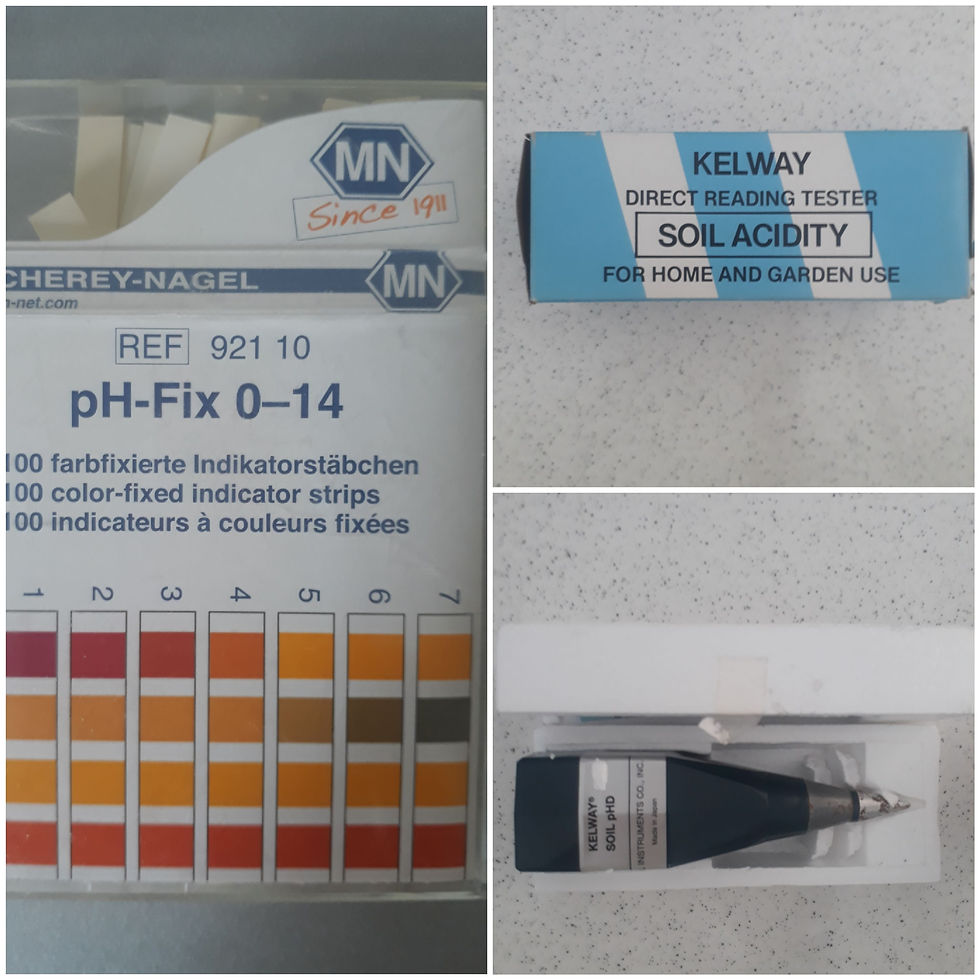
pH is the measurement of degree of acidity or alkalinity of the soil. The lower numbers are acid and the higher numbers are alkaline while a pH of 7 is called neutral. The nutrients that support growth usually cannot dissolve in soil moisture that is very acid or very alkaline.If they cannot dissolve ,they can't help a plant growth. Therefore, it needs regular testing so that soil productivity can be attained. You use pH meter test strips to measure the pH of each jar. For home use, soil tester can be alternatively preferred for direct measurement.
#Experiential learning #ESS #investigation #lab work


Comments